
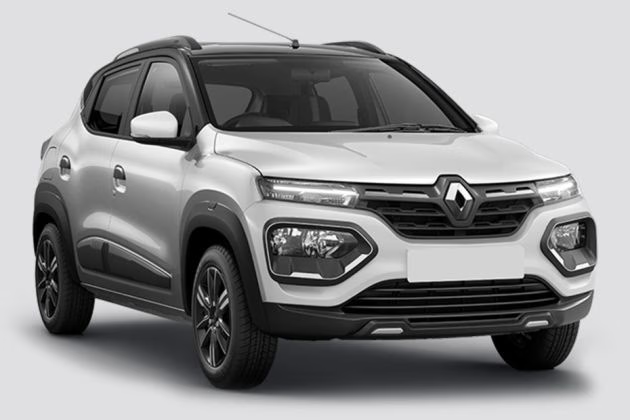
Renault Kwid
2015
The Renault Kwid is a crossover city car produced by the French car manufacturer Renault, initially intended for the Indian market and launched in 2015. In 2017, an improved Brazilian version was introduced for Latin American markets. Its battery electric version, named Renault City K-ZE, was launched in 2019, being manufactured in China and exported to Europe since 2021 as the Dacia Spring Electric and to Latin America since 2022 as Renault Kwid E-Tech.
History
The Kwid was developed under the project code BBA. It is the first car to be based on the new CMF-A platform jointly developed by Renault and Nissan. It is slightly longer but narrower than Renault's smallest conventional vehicle, the Twingo with a high sitting position and a 180 mm (7.1 in) ride height.
The car was designed by an engineers' team settled in India led by Gérard Detourbet, a senior engineer, former mathematician described as "an innovation a minute" who led the development team for the first-generation Dacia Logan.
The Kwid was unveiled at Chennai on 20 May 2015 by Renault's CEO Carlos Ghosn. Ghosn said the car would be "a game changer for Renault in India." The car has 98 per cent of parts localisation and extensive engineering by local Renault personnel. The Kwid is aimed at competing with other small cars within the Indian market, such as the Suzuki Alto, and incorporates uncommon equipment for its segment such as a digital instrument cluster and a multimedia touchscreen.
In September 2015, the Kwid was launched in India at a starting price of 257,000 rupees, equal to $3,884. Sales started in September and had a "flying start" of 25,000 bookings in 2 weeks and 50,000 in 5 weeks, then 70,000 in 2 months, getting 10% of effective market shares in its segment. The Indian version is exported to various overseas markets such as Sri Lanka, Indonesia, Tunisia and Sub-Saharan Africa.