
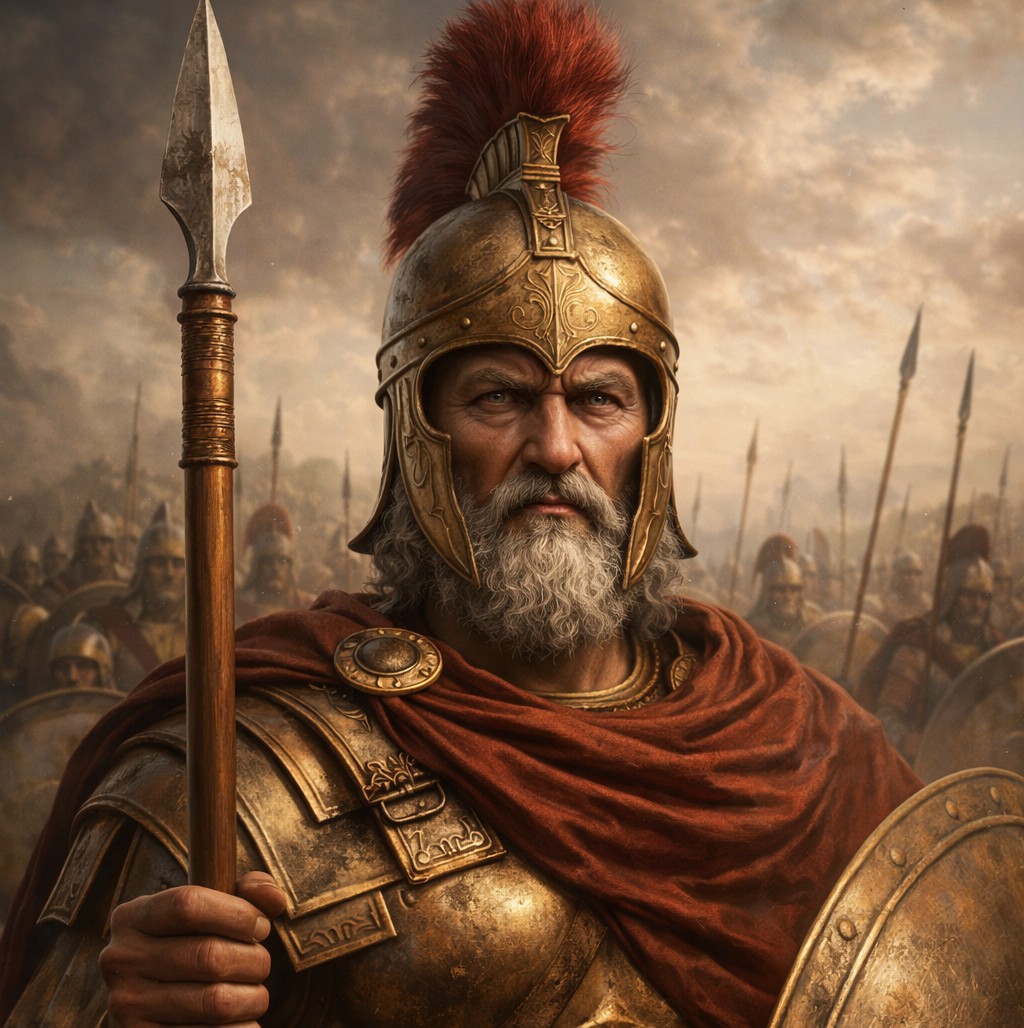
Miltiades
Born: 550 BC
Known for: his role in the Battle of Marathon, as well as for his downfall afterwards.
Died: 489 BC
Age: 60-61
Allegiance: Athens (City-state of the Delian League precursor)
Conflicts: Battle of Marathon (490 BCE) — key victory against Darius I of Persia
Cause of Death: Charged with treason, he was sentenced to death, but the sentence was converted to a fine of fifty talents. He was sent to prison where he died, probably of gangrene from his wound.
Resting Place: Athens
Spouses: Hegesipyle (Thracian princess), One unnamed Athenian wife
Miltiades (Ancient Greek: Μιλτιάδης Κίμωνος; c. 550 – 489 BC), also known as Miltiades the Younger, was a Greek Athenian statesman known mostly for his role in the Battle of Marathon, as well as for his downfall afterwards. He was the son of Cimon Coalemos, a renowned Olympic chariot-racer, and the father of Cimon, the noted Athenian statesman.
Miltiades was a well-born Athenian, and was accounted a member of the Aeacidae, as well as a member of the prominent Philaid clan. He came of age during the tyranny of the Peisistratids.
His family was prominent, due in good part to their success with Olympic chariot-racing. Plutarch claimed that Cimon, Miltiades's father, was known as "Coalemos", meaning "simpleton", because he had a reputation for being rough around the edges, but whose three successive chariot-racing victories at the Olympics made him popular, so popular in fact that, Herodotus claims, the sons of Peisistratos murdered him out of jealousy.
Miltiades was named after his father's maternal half-brother, Miltiades the Elder, who was also a victor at Olympic chariot-racing.
Miltiades's son Cimon was a major Athenian figure of the 470s and 460s BC. His daughter Elpinice is remembered for her confrontations with Pericles, as recorded by Plutarch.