
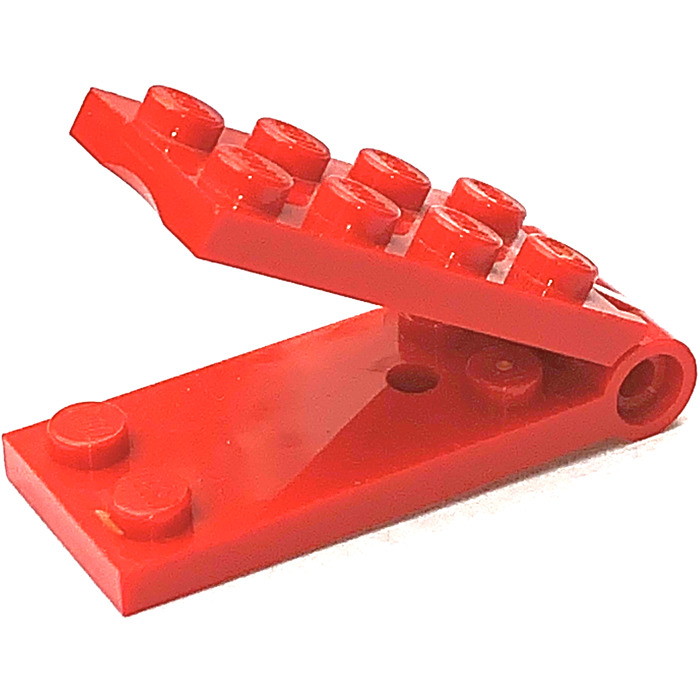
LEGO Hinges
1967
LEGO offers a wide range of hinge pieces that enable movement in models, connecting parts at various angles along a single axis. These parts are essential for creating functional doors, wings, roofs, and articulated structures.
Types of LEGO Hinges
LEGO hinges generally fall into two main categories: those with smooth rotation and those with "click-hinges" that lock into specific angles (usually 22.5° increments) for stronger, positionable joints.
Hinge Bricks and Plates: These are classic two-part hinge assemblies where one piece (the base with fingers/fork) connects to the other (the top plate/stub).
1x2 Hinge Plate (e.g., Part 3937 base and 3938 top): A compact and versatile option ideal for smaller movable elements like doors or small flaps.
1x4 or 2x4 Hinge Plate: Larger versions that provide more stability for bigger structures like shutters or vehicle roofs.
"Finger" and "Fork" System: Many modern hinges use a male/female connection system (often called "fingers" and "stubs" or "forks"). These are available as bricks, plates, and tiles in various sizes.
Locking Hinges: These pieces have small teeth on the connection point, providing strong friction so the joint stays in the desired position, such as a raised wing or an open door.
Swivel/Turntable Assemblies: For rotation around a single point rather than along an edge, LEGO offers turntable and swivel plates.
1x4 Swivel Base/Top (Part 3831/3830): Allows for circular movement, commonly used for vehicle steering or crane bases.
Turntables (e.g., 2x2, 4x4): These are ideal for structures that need to rotate 360 degrees, such as crane bases or spinning platforms.
Technic Joints: The LEGO Technic system uses a different set of parts for complex articulation.
Ball and Socket Joints: These allow movement on multiple axes at the same time, offering more complex positioning for mechanical arms or robot limbs.
Friction Pins and Beams: Technic parts can also create hinge-like movements by using friction pins to connect beams, which can be swung to different angles.
Building Applications
Builders use hinges to achieve various design goals in their creations (MOCs - My Own Creations):
Access: Hinges allow builders to create walls or floors that swing open to reveal detailed interiors, a common technique in modular buildings.
Shaping: They are crucial for creating non-linear or curved shapes, such as vehicle bodies, aircraft wings, or architectural details.
Functionality: Hinges provide realistic movement in vehicles (e.g., opening bonnets or boot lids), furniture (e.g., folding chairs), and machinery (e.g., excavators' arms).