
Israeli demolitions and evictions in East Jerusalem has fueled growing anger among Palestinians
2026, June 12
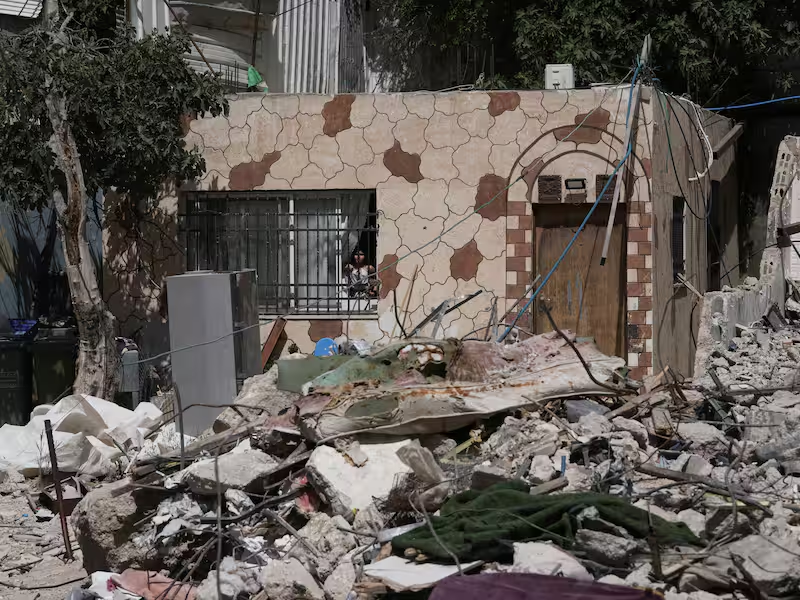
Israeli demolitions and evictions in East Jerusalem has fueled growing anger among Palestinians
2026, June 12
Israel
A recent surge in Israeli demolitions and evictions in East Jerusalem has fueled growing anger among Palestinians, who say entire communities are being displaced and their prospects for remaining in the city are being undermined.The focus is particularly on neighborhoods such as Al-Bustan and Batan al-Hawah in the Silwan area of East Jerusalem. Palestinian residents say homes that have been in families for generations are being demolished, often because they lack Israeli-issued building permits that Palestinians and rights groups argue are extremely difficult to obtain. Many residents describe the demolitions as destroying not only property but also their future in the city.
According to reports, more than 260 structures were demolished in East Jerusalem during 2025, with over 100 additional demolitions already recorded in 2026. Rights groups say the pace of demolitions has accelerated significantly in recent years.
Israel maintains that demolitions are carried out because buildings were constructed without the required permits and says planning laws apply equally to all residents. Palestinian residents, human-rights organizations, and many foreign governments dispute that characterization, arguing that planning and zoning policies disproportionately restrict Palestinian construction while facilitating expansion of Jewish neighborhoods and settlements.
The issue has become part of a broader international debate over Israeli settlement expansion and control of East Jerusalem and the West Bank. Several countries, including the UK, Canada, France, and Norway, have recently imposed sanctions on individuals and networks linked to settler violence, while European governments have expressed concern that settlement growth and displacement of Palestinians threaten the viability of a future Palestinian state.
East Jerusalem remains one of the most sensitive issues in the Israeli-Palestinian conflict. Palestinians envision it as the capital of a future state, while Israel considers Jerusalem its undivided capital. Most of the international community does not recognize Israel's annexation of East Jerusalem.