
Discarded upper stage of a SpaceX Falcon 9 rocket is believed to have crashed into the Moon
2026, August 5
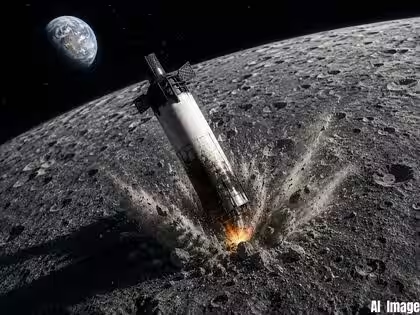
Discarded upper stage of a SpaceX Falcon 9 rocket is believed to have crashed into the Moon
2026, August 5
Moon
A discarded upper stage of a SpaceX Falcon 9 rocket is believed to have crashed into the Moon today in an unplanned impact that scientists have been tracking for months. The rocket stage, weighing about 4 metric tonnes and roughly the size of a school bus, was launched in January 2025 to send Firefly Aerospace's Blue Ghost 1 lunar lander toward the Moon. Because the mission required extra energy, the upper stage was left in deep space instead of being guided back to Earth.The impact is estimated to have occurred at around 8,700 km/h (5,400 mph) near the Moon's Einstein Crater, on the far western side of the lunar surface. The collision is thought to have excavated a crater roughly 18–27 metres (60–90 feet) across and thrown a cloud of lunar dust high above the surface.
Because the impact happened close to the Moon's limb (edge as seen from Earth), astronomers could not directly confirm it from Earth-based telescopes. Instead, NASA plans to use lunar orbiters to photograph the site in the coming weeks and compare before-and-after images. Scientists hope to:
Measure the size and shape of the new crater.
Study how lunar dust and rock are ejected by high-speed impacts.
Improve models of impact physics that are important for future Moon missions.
Refine methods for tracking spacecraft and other debris in cislunar space.
The event poses no danger to Earth. While unusual, it is not unprecedented. Previous spacecraft and rocket stages—including NASA missions and a Chinese rocket stage in 2022—have also struck the Moon, sometimes deliberately for scientific research and sometimes unintentionally.
The incident has also renewed discussions about managing space debris beyond Earth orbit, especially as lunar exploration accelerates under NASA's Artemis program and an increasing number of commercial and international missions head to the Moon.