
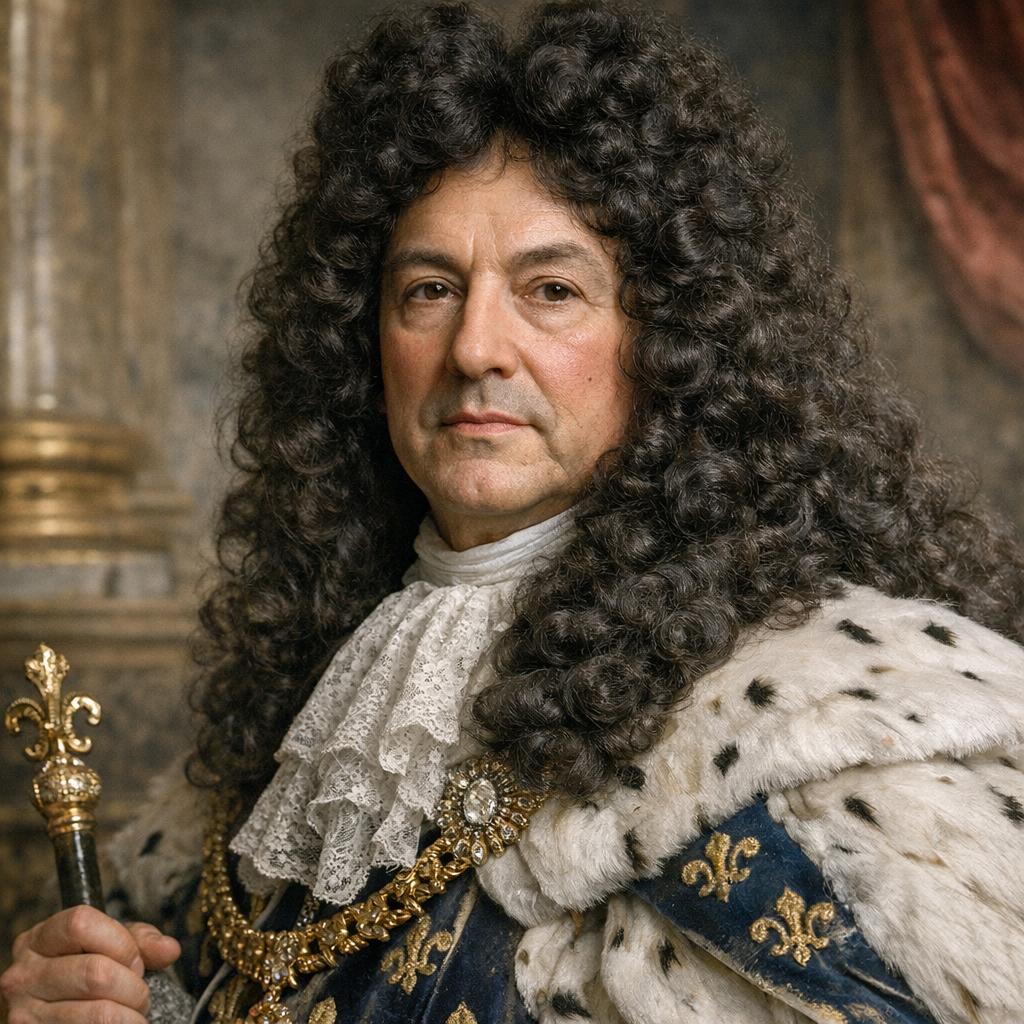
Louis XIV
Born: 5 September 1638
Known for: Known as the “Sun King,” was King of France.
Died: 1 September 1715
Age: 76
Allegiance: Kingdom of France; House of Bourbon
Conflicts: War of Devolution (1667–1668): Louis claimed the Spanish Netherlands as his wife's inheritance. It ended with the Treaty of Aix-la-Chapelle, granting France several fortified towns.
Franco-Dutch War (1672–1678): An attempt to punish the Dutch for their role in the previous war. It saw the rise of William III of Orange as Louis's lifelong rival.
Nine Years' War (1688–1697): Also known as the War of the Grand Alliance, it pitted France against a massive European coalition. It ended in a stalemate that forced Louis to return several earlier gains.
War of the Spanish Succession (1701–1714): A global conflict triggered by the death of the childless Charles II of Spain. Louis fought to secure the Spanish throne for his grandson, Philip V.
Cause of Death: Louis died of gangrene at Versailles on 1 September 1715, four days before his 77th birthday, after 72 years on the throne. Enduring much pain in his last days, he finally "yielded up his soul without any effort, like a candle going out", while reciting the psalm Deus, in adjutorium me festina (O Lord, make haste to help me).
Resting Place: His body was laid to rest in the Basilica of Saint-Denis outside Paris. It remained there undisturbed for about 80 years until revolutionaries exhumed and destroyed all of the remains found in the Basilica. In 1848, at Nuneham House, a piece of Louis's mummified heart, taken from his tomb and kept in a silver locket by Lord Harcourt, Archbishop of York, was shown to the Dean of Westminster, William Buckland, who ate a part of it. It is reported that a part of his heart and that of Louis XIII were used to obtain mummy-brown by Martin Drolling.
Spouses: Maria Theresa of Spain (m. 1660; died 1683)
Françoise d'Aubigné, Marquise de Maintenon (private) (m. 1683)Louis XIV (Louis-Dieudonné; 5 September 1638 – 1 September 1715) was King of France from 14 May 1643 until his death in 1715. He is a symbol of the Age of Absolutism in Europe for styling himself as "The Sun King" (Le Roi Soleil), which portrayed him as supreme leader. He presided over a great expansion of the French colonial empire and a patronage of arts in his court at the Palace of Versailles that defined the Baroque style of French architecture. His reign of 72 years and 110 days remains the longest of any sovereign monarch in history.
Louis XIV began his personal rule of France in 1661 after the death of his chief minister Cardinal Mazarin. A believer in the divine right of kings, Louis XIV continued Louis XIII's work of creating a centralized state governed from a capital. Louis XIV sought to eliminate the remnants of feudalism persisting in parts of France by compelling many members of the nobility to reside at his lavish Palace of Versailles. In doing so, he succeeded in pacifying the aristocracy, many of whom had participated in the Fronde rebellions during his minority. He consolidated a system of absolute monarchy in France that endured until the French Revolution. Louis XIV enforced uniformity of religion under the Catholic Church. His revocation of the Edict of Nantes abolished the rights of the Huguenot Protestant minority and subjected them to a wave of dragonnades, effectively forcing Huguenots to emigrate or convert, virtually destroying the French Protestant community.
During Louis' long reign, France emerged as the leading European power and regularly made war. A conflict with Spain marked his entire childhood, while during his personal rule, Louis fought three major continental conflicts, each against powerful foreign alliances: the Franco-Dutch War, the Nine Years' War, and the War of the Spanish Succession. In addition, France contested shorter wars such as the War of Devolution and the War of the Reunions. Warfare defined Louis's foreign policy, impelled by his personal ambition for glory and power: "a mix of commerce, revenge, and pique". His wars strained France's resources to the utmost, while in peacetime he concentrated on preparing for the next war. He taught his diplomats that their job was to create tactical and strategic advantages for the French military. Upon his death in 1715, Louis XIV left his great-grandson and successor, Louis XV, a powerful but war-weary kingdom, in major debt after the War of the Spanish Succession that had raged on since 1701.
Some of his other notable achievements include the construction of the 240 km (150 mi) Canal du Midi in Southern France, the patronage of artists (the playwrights Molière, Racine, the man of letters Boileau, the composer and dancer Lully, the painter Le Brun and the landscape architect Le Nôtre, all contributed to the apogee of French classicism, described during his lifetime as the "Grand Siècle", or even "the century of Louis XIV"), and the founding of the French Academy of Sciences.